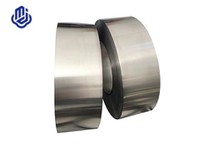
The surface reaction layer of titanium plate and titanium rod is the main factor affecting the physical and chemical properties of titanium workpiece. Before processing, the surface contaminated layer and defect layer must be completely removed. So how do you deal with surface defects?
1. Sand blasting:
The sandblasting treatment of titanium wire castings is generally better with white corundum, and the sandblasting pressure is smaller than that of non-precious metals, which is generally controlled below 0.45MPa. Because, when the injection pressure is too large, the sand impact titanium surface produces fierce sparks, and the temperature rise can react with the titanium surface, forming secondary pollution and affecting the surface quality. The time is 15-30 seconds. Only the sticky sand, sintered layer and part of oxidized layer on the surface of the casting can be removed. The remaining surface reactive layer structure should be quickly removed by chemical pickling.
2. Pickling:
Pickling can quickly and completely remove the surface reactive layer without contamination of other elements on the surface. Both HF-HCl system and HF-HNO3 system acid lotion can be used for pickling titanium, but HF-HCl system acid lotion absorbs more hydrogen, while HF-HNO3 system acid lotion absorbs less hydrogen, so the concentration of HNO3 can be controlled to reduce hydrogen absorption, and the surface can be brightening treatment. Generally, the concentration of HF is about 3%-5%. The appropriate concentration of HNO3 is about 15%-30%.
3. Chemical polishing:
Chemical polishing achieves the purpose of polishing through the REDOX reaction of metal in chemical medium. Its advantages are that chemical polishing has nothing to do with the hardness of the metal, polishing area and structure shape, where the parts in contact with polishing liquid are polished, no special complex equipment is required, simple operation, more suitable for the polishing of complex structure titanium denture support. But the process parameters of chemical polishing are difficult to control, so it is required to have a good polishing effect without affecting the accuracy of the denture. The better titanium chemical polishing liquid is prepared by HF and HNO3 in a certain proportion. HF is a reducing agent, which can dissolve titanium metal and play a leveling role. The concentration is <. 10%, HNO3 plays an oxidation role to prevent excessive dissolution of titanium and hydrogen absorption, and can produce brightening effect. Titanium polishing liquid requires high concentration, low temperature and short polishing time (1 ~ 2min).
4. Electrolytic polishing:
Also known as electrochemical polishing or anodic dissolution polishing, due to the low conductivity of titanium alloy tube, oxidation performance is very strong, the use of water acidic electrolyte such as HF-HO4, HF-H2SO4 system electrolyte to titanium almost can not polish, after the application of external voltage, titanium anode immediately oxidation, and the anodic dissolution can not be carried out. However, the use of anhydrous chloride electrolyte at low voltage has a good polishing effect on titanium, small specimens can get mirror polishing, but for complex restoration can not achieve the purpose of complete polishing.
Country:China
Add:Baoti road,Jintai,Baoji city,Shaanxi,China
Cel/Whatsapp :+86 18309262795
Email:annie@jmyunti.com
Website:www.jm-titanium.com