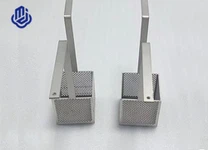
Titanium anode and titanium electrode are treated in water sterilization


Water treatment and sterilization currently generally adopts the oxidation disinfection method of adding chlorine or chloride to water. However, it is found that chlorination disinfection will cause the production of "three-hazard" (carcinogenic, teratogenic, mutagenic) substances in drinking water. Ultraviolet, ozone, ultrasound, magnetization, electrostatic and other treatment methods developed in recent years have not been widely used due to complex equipment, small water flow, or high treatment costs.
Electrolysis is popular as a sterilization water treatment technology with good sterilization effect, strong usability and no secondary pollution. Electrolytic sterilization is classified into indirect sterilization and direct sterilization:
1. Indirect sterilization: using electrolysis to produce ClO-, HclO3, H2O2, O2-, •OH- and other substances to kill microorganisms. Existing commercial disinfection processors mostly produce bactericides such as chlorine dioxide and sodium hypochlorite after adding electrolytes such as sodium chloride.
2. Direct sterilization: Direct sterilization uses electrolytic electrodes to directly act on microorganisms to kill them. Electrolytic sterilization mechanism: ⑴ Electrolyze chlorine-containing water to produce ClO- and a small amount of higher-valent chlorate. The reactions on the electrode are as follows: anode: 2Cl-2e→Cl2, Cl2+H2O→HClO+H++Cl-, OH- ions diffuse into the liquid layer around the anode and react with hypochlorous acid to produce ClO-, and further react to produce chloric acid: 12ClO-+6H2O- 12e→4HClO3+8HCl+3O2, the produced HClO and HClO3 are both strong oxidants, which have a strong killing effect on microorganisms. ⑵ When electrolyzing water without chloride ions, when the original water does not contain Cl-, it also has a good bactericidal effect, indicating that other oxidizing substances besides HOCl are produced during electrolysis. After analysis, the following reactions exist on the anode side: ①, H2O?→H++OH-, ②, 20H--2e→〔O〕+H2O→H2O2, ③4OH--4e→2H2O+02, ④〔O〕+O2→O3 Therefore, strong oxidizing disinfectants such as H2O2, O3, 〔O〕 are produced, so that the treated water has a strong bactericidal effect after electrolysis.
⑶Electrolysis directly acts on the bacterial cell body, destroys a certain bacterial organ, and causes the death of bacteria. The modern view of the bactericidal effect of chlorine is that it mainly acts through HClO. When HClO molecules reach the inside of bacteria, they can oxidize and destroy the bacterial enzyme system to kill the bacteria. The final products of oxidation are CO2 and H2O. Therefore, even if chlorine is used continuously, bacteria will not develop drug resistance.
Company: Baoji Dynamic Trading Co., Ltd
Country:China
Add:Baoti road,Jintai,Baoji city,Shaanxi,China
Cel:+86 18391896637(WHATSAPP)/18391894207
Gmail:alisa@jmyunti.com
Website:www.jm-titanium.com