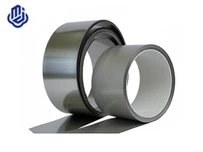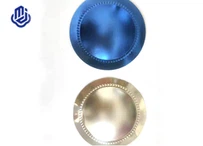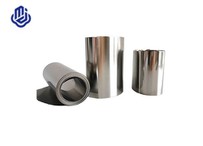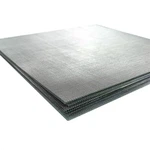

Products Description
The anode chemical foil is electrolytically etched by the smooth aluminum foil and then electrolyzed by the titanium anode for chemical foil to form an oxide film on the surface of the aluminum foil. The anode foil is electrolytically etched before it is electrolytically etched. The methods include direct current electrolytic etching and alternating current electrolytic etching. At present, direct current is generally used. The formation method is different due to different voltages. The current formation methods include constant current formation method and constant voltage formation method.
| Product name | Insoluble anode titanium plate for aluminum foil formation, oxide coated anode plate |
| Product specifications | 20-3000mm, can be customized according to customer needs |
| Product use | high, medium and low voltage aluminum foil formation lines and negative foil production lines |
| Product color | electrode black |
| Material composition | titanium-based coated electrodes, welding parts, etc. |
Aluminum foil has a broad market in my country, and a large amount of imports are made every year. The purpose of high-speed and high-precision rolling of aluminum foil is to improve the output, quality, yield and economic efficiency of aluminum foil. Compared with the international advanced level, my country still has a certain gap in this regard. From the perspective of aluminum foil production yield, my country is currently generally 60%-65%, while the foreign advanced level is 80%-85%; from the perspective of rolling speed, my country's current aluminum foil rolling mills generally fail to reach the designed maximum speed.

In the field of electronics industry, the demand for high-purity anodized aluminum foil has increased significantly in recent years. In order to obtain a uniform oxide film with high dielectric constant, it is necessary to anodize the aluminum foil in a special electrolyte. The current density is 10-50A/dm2. It is very difficult for current to pass directly through thin aluminum foil. It is necessary to install auxiliary anodes and auxiliary cathodes on both sides of the aluminum foil to energize the aluminum foil in a non-direct contact form.
Usually, the electrolyte contains organic matter, and the organic compounds are oxidized and decomposed on the anode, which pollutes the electrolyte. At the same time, the organic matter is adsorbed on the electrode surface, which significantly increases the electrode potential and destroys the coating. Therefore, the selection of insoluble anode materials is more difficult. Developing coated anodes with low oxygen overpotential and preventing anode passivation are difficult in aluminum foil anodizing.

Generally divided into four types: ultra-low voltage, low voltage, medium-high voltage and high voltage. According to thickness, it ranges from 25 to 110 microns; according to use, there are positive foil, negative foil and conductive foil. Generally, it is composed of anode foil and cathode foil. Anode foil is also called chemically formed foil. Its foil thickness is 0.03 to 0.12 mm, and its withstand voltage ranges from 8V to 800V.
It is formed by electrochemical or chemical corrosion of high purity (more than 99.9%) to treat the surface into a sponge/tunnel structure to increase its surface area, and then anodize the electro-etched foil to form a dense aluminum oxide film (aluminum oxide) on the surface.

Products show


Company introduction

FOCUSED ON HIGH OUALITY TITANIUM MATERIAL
Our company supplies aluminum foil formed anode plate materials according to the specific requirements of customers. We use industrial pure titanium TA1 as the titanium anode substrate, and the coating system is an iridium-tantalum system mixed precious metal oxide coating. The titanium anode coating has an enhanced life of 21 days measured in the laboratory (based on many years of practical application and experience, our company has measured in the laboratory that the normal service life of 18 months corresponds to an enhanced life of 18 days; the laboratory test medium is 10% ammonium adipate solution, the enhanced current density is 4000A/㎡, and the test conditions are strictly in accordance with Q/YLD-JZ-01-2010 standard).

The actual working voltage drop of the titanium anode plate in the powered cell is about 15V-20V. The anode plate coating has a high electrocatalytic efficiency and a low precipitation potential, and the cell voltage also decreases accordingly, which reduces energy consumption for customers by about 20%, increases production efficiency, saves costs, and establishes a long-term partnership with the customer.

Product Process
1. Purchase the GR1 titanium substrate to ensure that the surface of the plate is smooth and flat, without deep scratches and defects.
2. Machining the purchased titanium substrate and processing it to the size required by the customer.
3. Annealing and leveling the titanium substrate at a temperature of >500 °C. (To eliminate stress and ensure flatness.)
4. When the annealing leveling treatment, a dense titanium oxide layer is formed on the surface of the titanium substrate, and it is polished by mechanical or artificial means, and the surface thereof is made of titanium metallic luster.
5. The titanium substrate is subjected to pickling etching with 10% strength oxalic acid, and is subjected to a micro-boiling state for several hours to etch the surface oxide layer into a titanium hydride surface.
6. Qualitative and quantitative configuration of the precious metal solution according to the anode environment applied by the customer.
7. Detecting that the pickled titanium substrate is qualified, that is, the surface layer is gray uniform matte structure, and then manually coating and arranging, sintering at a set temperature, sintering naturally, cooling, and cooling to normal temperature for a second coating Resume, and so on, until the configuration solution is finished after 17~20 times.
8. After the sintering of the above processed parts is completed, the life test will be carried out with the test piece of the furnace, and the qualified package will be shipped.

How to choose the titanium anode for aluminum foil formation?
How to choose a titanium anode for aluminum foil formation?
The selection of titanium anode for aluminum foil formation should be analyzed from the following aspects:
1. Product structure
Titanium anode is generally composed of titanium matrix and anode material. The titanium matrix usually uses industrial pure titanium TA1, TA2 or TA3, which has the advantages of good corrosion resistance, high mechanical strength and easy processing. The anode material is selected according to the specific use environment and needs.
2. How to choose the product
1. Determine the polarity of the required anode. Generally speaking, aluminum foil formation requires a cathode, so a titanium anode suitable for the cathode should be selected.
2. Consider the current density and voltage range. These parameters need to be determined according to the production process and equipment of aluminum foil. Generally, the anode is required to work stably within a certain current density and voltage range.
3. Consider the corrosion resistance and mechanical strength of the anode material. Since highly corrosive molten salts and gases are used in the production process of aluminum foil, the anode material is required to have good corrosion resistance and mechanical strength to extend the service life and ensure production safety.
4. Determine the size and shape of the anode. These factors need to be selected according to the actual situation of the aluminum foil production equipment. Generally, the contact area between the anode and the production equipment is required to be large enough to reduce energy consumption and enhance thermal conductivity.
3. Product advantages
Titanium anode has excellent corrosion resistance and high thermal conductivity, which can effectively improve the production efficiency and product quality of aluminum foil, while extending the service life of the anode, reducing production costs and energy consumption, and is an ideal choice for aluminum foil formation.
4. Usage scenarios
Aluminum foil titanium anode is mainly used in aluminum foil production lines, including molten salt electrolytic cells, cathode ray curtain walls and other key parts. It has excellent corrosion resistance and high thermal conductivity, which can effectively improve the production efficiency and product quality of aluminum foil, extend the service life of the anode, reduce production costs and energy consumption, and is an ideal choice for aluminum foil formation.
Shipping and Packing
Transportation method
Express (DHL, Fedex, UPS, national special line) air transportation, sea transportation, land transportation, multiple ways to meet your needs
Port:
Tianjin, Shanghai, Qingdao or any other Chinese main port.
Lead Time:
2-15 days after payment confirmed.

Packaging Details:
1. Inside: Kraft papers, plastic bags, polyethylene foamed sheet;
2. Outside: packing: wooden box;
3. Or according to customer requirement.

Contact
Contact us for more information. Thank you
Nicole
Company: Baoji Jimiyun Dynamic Co., Ltd
Country:China
Add:Baoti road,Jintai,Baoji city,Shaanxi,China
Cel:+86 18391896637
Gmail:Nicole@jmyunti.com
Website:www.jm-titanium.com
Hot Tags: titanium anode for electrochemical formation of aluminum foil, China, suppliers, manufacturers, factory, customized, wholesale, buy, price, cheap, sale, quotation, in stock, free sample, square titanium nut, Gr5 titanium alloy sheet, ti on the periodic table, titanium screw DIN85, medical titanium rod, DIN 6912 titanium bolt