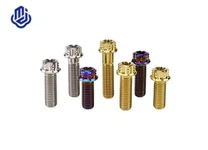


The forging process of titanium alloys is widely used in aviation and aerospace manufacturing.
The main characteristics of titanium alloys are small specific gravity, high strength, and good heat resistance and corrosion resistance. They have become the main material of modern aircraft stress components, which greatly reduces the weight of aircraft. Among them, TC4 (Ti-6AL-4V) and TC4 (Ti-6AL-4V) and TB6 titanium alloy forgings are widely used in aviation manufacturing.
Classification of titanium alloys and forging processes
According to the microstructure at room temperature, titanium alloys can be divided into three types: α-type alloys, α+β-type alloys and β-type alloys. Among them, the thermoplasticity of α and α+β-type alloys has little relationship with the deformation rate, while the β-type alloys have little relationship with the deformation rate. Good forgeability but too low temperature may cause α-phase precipitation.
The forging process of titanium alloy is divided into conventional forging and high temperature forging according to the relationship between forging temperature and beta transformation temperature.
Conventional forging of titanium alloys
Commonly deformed titanium alloys are usually forged below the beta transformation temperature, which is called conventional forging. According to the heating temperature of the billet in the (α+β) phase region, it can be subdivided into the upper two-phase region forging and the lower two-phase region forging.
Lower two-phase forging
Forging in the lower two-phase region is generally performed by heating and forging at 40 to 50 °C below the β transformation temperature. At this time, the primary α phase and β are the same and participate in the deformation. The lower the deformation temperature, the greater the number of α phases involved in the deformation. Compared with the deformation in the β region, the recrystallization process of the β phase in the lower two-phase region is rapidly accelerated, and the new β grains formed by recrystallization not only precipitate along the deformed original β grain boundaries, but also in the β grain boundaries and α sheets. occurs within the β-interlayer. The forgings produced by this process have high strength and good plasticity, but their fracture toughness and creep properties still have great potential.
Upper two-phase forging
It starts forging at a temperature of 10-15°C below the β/(α+β) transformation point. The final microstructure after deformation contains more β-transformation microstructure, which can improve the creep performance and fracture toughness of the microstructure, and make the titanium alloy have both plasticity, strength and toughness.
High temperature forging of titanium alloys
Also known as "beta forging", it is divided into two types: the first is a process method in which the billet is heated in the beta area, and the forging is started and completed in the beta area; the second is the billet is heated in the beta area, and the forging begins in the beta area. And control a large amount of deformation to complete the forging process in the two-phase region, referred to as "sub-beta forging". Compared with two-phase region forging, β forging can obtain higher creep strength and fracture toughness, and is also beneficial to the improvement of cyclic fatigue properties of titanium alloys.
Isothermal forging of titanium alloys
This process uses the superplasticity and creep mechanism of the material to produce more complex forgings, requiring the die to be preheated and kept in the range of 760-980 °C; the hydraulic press applies pressure at a predetermined value, and the working speed of the press is determined by the blank. Deformation resistance is automatically adjusted. Since the mold is changed to heated, there is no need to use such a fast moving beam to avoid quenching. Many forgings used in aircraft have the characteristics of thin wall and high rib, so this process has been applied in aviation manufacturing, such as the isothermal precision die forging process of TB6 titanium alloy for a certain type of domestic aircraft.