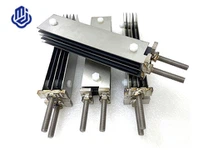
Precise retraction and extension on the landing gear of spacecraft, gentle support for the hope of life in medical equipment, and light handling of complex road conditions in high-end cars... Titanium alloy springs, with their unique performance advantages, are becoming indispensable key components in many high-end fields
Frist. Outstanding performance: Multi-dimensional advantages are fully demonstrated
★Titanium alloys with both high specific strength and elasticity (such as TC4 and TA18) demonstrate powerful comprehensive performance. Its strength is comparable to that of steel, with tensile strength reaching 800-1100 MPa, but its density is only 60% of that of steel. This characteristic of low density and high strength enables titanium alloy springs to be significantly lighter under the same load-bearing capacity. Meanwhile, its elastic modulus (110-120 GPa) is lower, which can provide greater elastic deformation capacity. It has a high elastic specific energy and better energy storage capacity than steel. In scenarios that require high energy absorption, such as shock-absorbing springs, titanium alloy springs can more effectively absorb and release energy, providing stable elastic support for equipment.
★ Super corrosion-resistant titanium alloys have an "immunity" to corrosive media such as seawater, chloride ions, and body fluids. In Marine environments, ordinary metal springs are prone to rust and damage due to the erosion of seawater, which affects the normal operation of equipment. Titanium alloy springs can work stably for a long time without the need for additional anti-corrosion treatment. In the medical field, as implants such as heart stent springs, titanium alloy springs do not undergo chemical reactions with body fluids, avoiding the harm of harmful substances produced by corrosion to the human body and ensuring the health and safety of patients.
★. Long fatigue life: The fatigue limit of titanium alloys can reach 50% to 60% of their tensile strength, while that of steel is approximately 40%. This means that under high-frequency dynamic loads, such as the valve springs of aero engines, titanium alloy springs can withstand more cycles without fatigue fracture. Its long service life reduces the maintenance cost and replacement frequency of the equipment, enhancing its reliability and safety.
★ Non-magnetic and biocompatible titanium alloys are non-magnetic. This characteristic enables them to function normally in an MRI (magnetic resonance Imaging) environment without interfering with the imaging results. Meanwhile, titanium alloys have passed ISO 5832-3 medical certification, such as TA1 pure titanium or TC4 ELI, and have good biocompatibility, which will not cause rejection reactions in the human body. They are widely used in the field of medical implants.
Second, meticulous Craftsmanship: Overcoming Difficulties to Create quality products
1. Material selection: Precise matching of demands Different application scenarios have varying performance requirements for titanium alloy springs, so it is necessary to precisely select the appropriate alloy materials. TC4 (Ti-6Al-4V) has excellent comprehensive performance and a moderate cost, making it suitable for most spring applications. TA18 (Ti-3Al-2.5V) has better high-temperature resistance and can be used in environments with a temperature of ≤450℃, such as engine valve springs. Pure titanium (TA1/TA2) has excellent plasticity but low strength, making it suitable for low-load springs, such as those in situations where strength requirements are not high but good elasticity is needed.
2. Forming process: Cold and hot forming each present challenges. Cold forming: Suitable for wire materials with a diameter of ≤ 6mm, such as medical micro springs. However, titanium alloys harden rapidly during cold working, and intermediate annealing (700-800 ℃) is required during cold forming to restore the material's plasticity. Meanwhile, the large springback is one of the difficulties in cold forming, which is 20% to 30% higher than that of steel. To solve this problem, it is necessary to ensure that the dimensional accuracy of the spring meets the requirements through mold compensation design or multiple forming corrections. Hot forming: The temperature range is 750-900 ℃ (TC4) or 700-850 ℃ (TA18). During the hot forming process, inert gas protection is required to prevent material oxidation. The advantage of hot forming lies in its ability to process large-sized springs, such as helical springs used in aviation, and it can reduce residual stress and enhance the performance stability of the springs.
3. Heat treatment: Key to optimizing performance - Stress relief annealing: Annealing treatment at 500-650 ℃ for 1-2 hours can eliminate cold working stress, enhance the dimensional stability of the spring, and reduce deformation during use. Solution treatment + aging (only for α - β alloys such as TC4) : First, carry out solution treatment (water quenching at 900-950 ℃), followed by aging treatment (480-550 ℃× 4-8 hours), which can increase the strength of the spring by 10%-15% and further enhance its load-bearing capacity.
4. Surface treatment: Enhancing performance and lifespan Shot peening strengthening: By shot peening treatment, a compressive stress layer is formed on the surface of the spring, with a depth of up to 0.1-0.2mm, effectively increasing the fatigue life of the spring and enhancing its resistance to fatigue fracture. Anodizing: It generates a TiO₂ film (5-20 μm), which not only enhances the wear resistance of the spring but also improves its insulation, making it suitable for applications where both wear resistance and insulation are required.
5. Welding and connection: Ensuring structural stability. Laser welding is often used for the connection of closed end springs. During the welding process, it is necessary to strictly control the heat input to prevent the roughening and embrittlement of the β phase, which may affect the performance of the spring. Precise welding techniques can ensure the structural stability and reliability of the spring.
Country:China
Add:Baoti road,Jintai,Baoji city,Shaanxi,China
Cel/Whatsapp :+86 18309262795
Email:annie@jmyunti.com
Website:www.jm-titanium.com