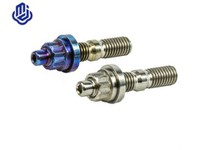
The basic steps of forging titanium Damascus grain
Gmail:alisa@jmyunti.com
Forging titanium Damascus patterns is a complex and delicate process that combines technologies from multiple fields such as metal processing, heat treatment, and surface treatment. The following is a general forging process
Designing patterns:
First, the desired titanium Damascus patterns need to be designed according to the needs. This usually involves aesthetic and functional considerations for the final product.
Preparing materials:
Select high-quality titanium materials as substrates. The choice of titanium materials is critical to the performance and quality of the final product.
Substrate cleaning and surface treatment:
The titanium substrate is thoroughly cleaned to remove dirt and grease from the surface. Then, surface treatment such as sandblasting or pickling may be required to increase the adhesion of the material and the uniformity of subsequent processing.
Texture processing:
Folding forging: A common method is to use folding forging technology. This involves folding and forging the titanium material multiple times to form the desired texture. Each fold and forging rearranges the grains in the material, resulting in a unique texture.
Other processing methods: In addition to folding forging, other processing methods such as laser cutting, chemical etching, etc. can also be used to assist in the formation or enhancement of textures.
Heat treatment:
Heat treatment is one of the key steps in the forging process. By controlling the heating and cooling process, the microstructure and properties of titanium materials can be changed to optimize its hardness, strength and corrosion resistance. For the formation of titanium Damascus lines, heat treatment also helps to fix and enhance the lines.
Surface grinding and polishing:
After heat treatment, the titanium material needs to be surface ground and polished. This not only removes surface defects and oxide layers, but also makes the lines clearer and more beautiful.
Corrosion baking:
In some cases, in order to further enhance the visual effect of titanium Damascus lines, corrosion baking may be performed. This involves corroding the surface of the material with specific chemical reagents and then heating it to give it a unique color and texture.
Quality inspection:
After the entire forging process, the product needs to be strictly inspected for quality. This includes checking the clarity, consistency, uniformity of the lines, as well as the overall performance and appearance quality of the product.

Company: Baoji Dynamic Trading Co., Ltd
Country:China
Add:Baoti road,Jintai,Baoji city,Shaanxi,China
Cel:+86 18391896637(WHATSAPP)/18391894207
Gmail:alisa@jmyunti.com
Website:www.jm-titanium.com