
Type I: color anodizing
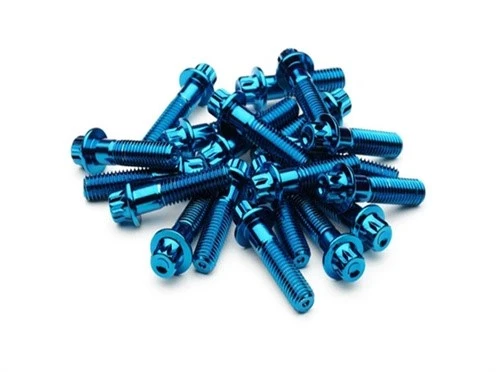
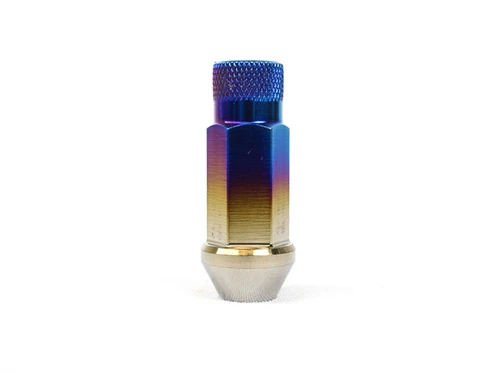
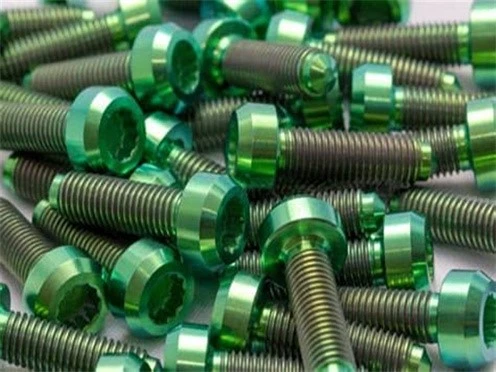
Titanium is a member of a group of metal elements (including niobium and tantalum) that can be color-anodized because of its "reactivity," that is, it can be stimulated in an electrolyte by heating or electrification to generate a thin layer of oxide on the surface. This oxide takes on its own color due to the phenomenon of light interference. This is a very thin transparent layer, and when the white light is reflected off the surface of the base metal, its "color" is "interfered" in the oxide layer. Light waves at certain frequencies escape and recombine with surface light, enhancing or cancelling them out to produce the colors we see. As the thickness of the oxide layer increases, light waves of different frequencies escape, resulting in different colors. The resulting colors appear in sequential order of up to five colors repeated at a time. Not all colors in the spectrum can be generated. "Big Red" and "Forest Green" cannot be generated. The color anodized coating is extremely thin (about 50 to 200 nm). Although it is harder than titanium parts themselves, it cannot show excellent wear resistance because the oxide film is so thin. The color is controlled by applying voltage to the component through the electrolyzer. A variety of electrolytes can be used to produce coatings. The component acts as a positive electrode (anode) in the electrolyte, while the corresponding negative electrode (cathode) end is connected to a DC power supply. A number of processes can be used to "selectively" anodize the surface. In the medical device industry, color anodizing is mainly used for product aesthetics and/or identification. For example, medical staff in the operating room may need the help of magenta, blue, gold, green and bronze "colors" to distinguish at a glance between multiple screws of the same diameter and different lengths. It is important to know that the color of the metal itself has not changed - unlike in anodizing aluminum, there are no dyes or pigments present. Instead, this thin layer of transparent oxide produces an "interference" color. Anodized titanium implants are both biocompatible and hypoallergenic because they are free of dyes and pigments. There are many ways of anodizing and coloring titanium and titanium alloys. The main factors affecting the oxide film are electrolyte and electrolytic voltage. These two factors are classified from a large number of literatures. According to the type of electrolyte used, it can be divided into acidic solution, alkaline solution, salt solution and mixed solution. According to the power supply used, it can be divided into DC oxidation method, AC oxidation method and pulse oxidation method.



Type II: micro arc oxidation
Micro-arc oxidation, also known as plasma micro-arc oxidation, is a new technology for growing oxide ceramic films on the surface of non-ferrous metals such as Al, Mg and Ti. The technology directly transforms the matrix metal into oxide ceramics by sintering at high temperature and high pressure in the micro-arc discharge area. It has the characteristics of high production efficiency, simple and economical process, high bonding strength between the wear-resistant ceramic oxide film and the substrate, and can prepare a thicker coating with controllable coating thickness, etc., which has attracted the attention of researchers all over the world. The micro-arc oxidation technology has the following advantages: the ceramic film is grown in situ, so its binding degree is relatively high; The composition and properties of the film were changed by adjusting the process conditions of the electrolyte composition, and the functional design of the film was improved effectively. The performance of the matrix will not deteriorate when the instantaneous discharge temperature is relatively high. Even the complex shape of the workpiece can be formed on the internal and external surfaces; Simple operation, cost-effective, fewer pre-treatment processes, no need for high temperature or vacuum conditions; Combined with the advantages of ceramic and metal materials, the corrosion resistance and wear resistance of metal materials are effectively improved. The surface of titanium alloy and pure titanium products exposed to air or water in a natural state can form an oxide film, which can be thickened by electrochemical surface treatment of anodic oxidation. Adjusting the voltage of the anodic oxidation surface treatment process can control the thickness of the oxide film, the visible light diffraction of the oxide produces a unique color, and various different colors are determined by the thickness of the oxide film. It can be seen from the research data that there is no pigment or organic dye in the oxide film formed by anodic oxidation process.
Country:China
Add:Baoti road,Jintai,Baoji city,Shaanxi,China
Cel/Whatsapp :+86 18309262795
Email:annie@jmyunti.com
Website:www.jm-titanium.com


