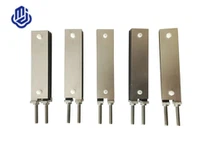
High purity titanium target production process and application field?
Gmail:alisa@jmyunti.com
Raw material preparation:
Select high-purity titanium raw materials: Generally, the purity is required to be 99.9% or above. For high-end application fields such as semiconductors, the purity requirement is higher, which may reach 99.995% or even 99.999%2. High-purity titanium raw materials can reduce the impact of impurities on the performance of sputtered films2.
Raw material processing: Pre-treat titanium raw materials such as sponge titanium to remove impurities such as oxides and oil stains on the surface to ensure the smooth progress of the subsequent smelting process.
Smelting:
Vacuum induction melting: In a vacuum environment, the titanium raw materials are melted by induction heating. This method can effectively prevent titanium from reacting with oxygen, nitrogen and other gases in the air at high temperatures, thereby ensuring the purity of the titanium target. At the same time, induction melting can fully stir the titanium liquid and make the composition more uniform1.
Vacuum arc melting: The titanium raw materials are melted by the high temperature generated by arc discharge. During the smelting process, an arc is formed between the electrode and the titanium raw material, releasing a large amount of heat energy to melt the titanium. Vacuum arc melting can precisely control the melting temperature and time, which is conducive to obtaining high-quality titanium targets1.
Vacuum electron bombardment melting: Use the high energy of the electron beam to bombard the titanium raw material to melt it. The energy of electron bombardment melting is concentrated, which can quickly heat the titanium raw material to a high temperature, and can precisely control the melting process, which is of great significance for the preparation of high-purity and high-performance titanium targets1.
Ingot: Pour the smelted titanium liquid into a pre-designed mold, and form a titanium ingot after cooling and solidification. The shape and size of the ingot are determined according to the requirements of subsequent processing, and common ones are cylindrical, square, etc.
Processing and forming:
Machining: Mechanical processing of titanium ingots, such as cutting, forging, rolling, grinding, etc., to achieve the required shape and size. For example, the ingot is cut into sheets by cutting, and then rolled or ground to meet the requirements for surface flatness and dimensional accuracy.
Precision machining: For some titanium targets with extremely high requirements for dimensional accuracy and surface quality, precision machining is also required, such as electrospark machining, laser machining, etc. These processing methods can achieve high-precision processing without damaging the titanium target.
Heat treatment: The titanium target after processing is heat treated to eliminate internal stress and improve its structure and performance. Parameters such as heat treatment temperature, time and cooling method need to be strictly controlled according to the specific requirements of the titanium target.
Quality inspection: The purity, density, grain size, crystal orientation, geometry and size of the titanium target are inspected to ensure that it meets the relevant standards and requirements. The inspection methods include chemical analysis, metallographic analysis, X-ray diffraction analysis, scanning electron microscope analysis, etc.
Application areas of titanium targets:
Semiconductor field:
Metal interconnect layer: In the process of integrated circuit chip manufacturing, titanium targets can be used to make metal interconnect layers to connect various circuit elements in the chip. Titanium has good conductivity and adhesion, which can ensure the reliability and stability of the metal interconnect layer and improve the speed and performance of the chip.
Barrier layer: In the metallization process of semiconductor devices, titanium can be used as a barrier layer material to prevent metal from diffusing into semiconductor materials and avoid affecting the performance of semiconductor devices.


Display panel field:
Transparent conductive layer: In display panels such as liquid crystal displays (LCDs) and organic light-emitting diodes (OLEDs), titanium targets can be used to prepare transparent conductive layers. Titanium oxides (such as titanium dioxide) have good conductivity and light transmittance, which can improve the brightness and contrast of display panels.
Reflective layer: In the backlight system of the display panel, titanium targets can be used to make reflective layers to improve the reflection efficiency of the backlight, thereby increasing the brightness of the display panel.
Solar cell field:
Back electrode: In solar cells, titanium targets can be used to prepare back electrodes. The function of the back electrode is to collect the current generated by the solar cell and transmit it to the external circuit. Titanium has good conductivity and corrosion resistance, which can ensure the long-term stability of the back electrode.
Transparent conductive layer: Similar to display panels, the transparent conductive layer of solar cells can also be prepared using titanium targets to improve the photoelectric conversion efficiency of solar cells.
Optical device field:
Reflective coating: In optical components such as lenses, filters, and lasers, titanium targets can be used to prepare reflective coatings. Titanium has a high reflectivity and can effectively reflect light and improve the performance of optical components.
Anti-reflective coating: By coating a layer of titanium compound (such as titanium dioxide) on the surface of optical components, an anti-reflective coating can be formed to reduce the reflection and scattering of light and improve the transmittance of optical components.
Medical equipment field:
Surface coating: Titanium targets can be used to make surface coatings for medical implants such as artificial bones, teeth, and heart valves. Titanium has good biocompatibility and corrosion resistance, can be well combined with human tissue, and will not cause adverse reactions to the human body.
Decorative coating field: It can be used for glass decorative coating, wheel hub decorative coating, tool and mold coating, etc., which can give objects beautiful appearance and good wear resistance, corrosion resistance and other properties.
Company: Baoji Dynamic Trading Co., Ltd
Country:China
Add:Baoti road,Jintai,Baoji city,Shaanxi,China
Cel:+86 18391896637(WHATSAPP)/18391894207
Gmail:alisa@jmyunti.com
Website:www.jm-titanium.com