Development status of high-strength and high-elasticity titanium alloys
The elastic deformation ability of metal materials is affected by the yield strength and elastic modulus, and the elastic limit (ε0.2) of the tensile line is generally less than 1%. The strength of traditional titanium alloy is in the range of 400~1500 MPa according to the alloy grade, the elastic modulus is between 50~120 GPa, which is much lower than steel (about 210 GPa), and the elastic deformation capacity is about twice that of steel. Titanium alloy has excellent elastic deformation ability due to its high strength and low elastic modulus, and is widely used in the aerospace field.
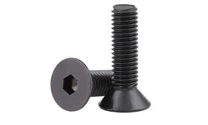
In the 1950s, the United States first used TI-6AL-4V titanium alloy bolts on the B-52 bomber, opening the application of titanium alloy fasteners in the aerospace field. With the continuous lightweight requirements of aerospace and weaponry, the application of lightweight, high-strength, and high-elasticity titanium alloys in fasteners has gradually replaced the traditional 30CrMosia steel, improving the safety and reliability of the equipment. Currently commonly used α+β and β-type titanium alloys, such as Ti-6Al-4V, Ti-3Al-5Mo-4.5V, Ti-5Mo-5V-8Cr-3Al and Ti-15Mo-3Al-2.7Nb-0.3Si ( β 21S), etc., the tensile strength is basically 1000 MPa level.
Since the 1970s, McDonnell Douglas has been using TI-13V-11CR-3AL to manufacture civil aircraft springs, replacing spring steel and reducing weight by 70%. Later, Lockheed, Boeing and Airbus began to use β-titanium alloy materials to make spring components, such as landing gear locks, hydraulic return, and aircraft control. Typical alloys are Ti-15V-3Cr-3Al-3Sn and Ti-3Al-8V-6Cr-4Mo-4Zr (β-C), and their elastic modulus is about 104 GPa. The tensile strength is 1300~1450 MPa.
Typical brands used in China are TB2, TB3 and TB5. At present, α+β and β-type titanium alloys used for springs and fasteners generally adopt α+β two-phase structure to obtain high strength. At the same time, the modulus of elasticity (90~120 GPa) is also higher, resulting in lower elastic properties. Therefore, it is difficult to meet the requirements of advanced aircraft for high-strength and high-elastic materials. As a special rivet material, β-type Ti-45Nb alloy has been widely used in aerospace products at home and abroad. The alloy has the advantages of low elastic modulus, good plasticity, and good cold working formability, but the strength, especially the yield strength, is low, and the strength and elastic properties are poorly matched.
Since the 1990s, in order to reduce the elastic modulus of medical titanium alloys, a series of low elastic modulus metastable β-type titanium alloys have been developed, such as Ti-29NB-13Ta-4.6Zr and Ti-35NB-5Ta- 7Zr, etc., to obtain better elastic properties. However, this titanium alloy was developed for the medical field. The strength of titanium alloy is low, and it is difficult to meet the high strength and high elasticity requirements of titanium alloy for aviation fasteners and springs. In 2003, Toyota Central Research Institute of Japan developed a multi-functional titanium alloy (rubber metal) with excellent comprehensive properties. The typical composition is ti-23nb -0.7 ta-2zr -1.2 2o (atomic fraction %). The alloy is deformed by 90% cold rolling. The back strength can reach 1200 MPa, the elastic modulus is 55 GPa, and the elastic limit can reach about 2.5%. It shows excellent matching of high strength and high elasticity. The alloy has constant elasticity in a wide temperature range.
The metastable β-type alloy Ti-24Nb-4Zr-8Sn (Ti-2448) developed by the Institute of Metal Materials of the Chinese Academy of Sciences also shows excellent elastic properties, with its elastic modulus as low as 42 GPa and elastic strain as high as 3.3%. After solution aging treatment, it also has excellent high strength and high elasticity matching. Rubber metal and TI-2448 are typical representatives of advanced high-strength and high-elasticity titanium alloys. This shows that titanium alloys can achieve high-strength and high-elasticity matching. Its excellent performance depends on ingenious component design and appropriate preparation technology.
Nicole
Cuntry:China
Add:Baoti road,Jintai,Baoji city,Shaanxi,China
Cel:+86 13369210920
Gmail:nicole@jmyunti.com